Showing posts with label 4-2-3-1. Show all posts

Tuesday, March 20, 2012

The Secret of Swansea's Success

There is no secret to Swansea’s success....

Swansea City are the latest newly promoted side to charm the neutrals and earn the respect of opponents throughout the Premier League. Following their 3-0 away victory over Fulham they currently lie 8th in the table – only three points off Liverpool, by mid-March find themselves just one point off the magic 40 generally reckoned to ensure safety in the division.


Blackpool similarly impressed match-goers, TV audiences and pundits in their 2010-11. They stuck to their guns by playing the same expansive and entertaining game that they had been promoted using. Sadly they fell short, but during the season they had wins over Liverpool (twice) and Tottenham, and some memorable away victories. West Bromwich Albion seem to do it on a 2-4 year cycle. Almost every year, at least one of the clubs promoted to the Premier League raise eyebrows with attacking play.
But this should not be such a surprise. Promoted teams have, by definition, had very successful league campaigns the year before. The same question is always posed to these clubs. Stick or twist? It applies not only to style of play, but also to investment. A Chairman can choose to rubber stamp ambitious moves for players with good experience or great promise, paying out on transfer fees and extravagant wages, or they can cautiously withhold funds (If indeed funds are available) and hope that the existing playing and non-playing staff can withstand the onslaught. The manager too is asked the same question, and of course in discussion with the money men at the club will choose to either stay true to their attacking ideals or try to adopt a defensive approach. The two questions are inextricably interlinked. Strangely though, although one decision informs the other, it’s often the case that if the decision is made to stick with the system, investment is made, and conversely if a club decides to change tack from attacking expansive football to gritty survival football, then the money isn’t spent. So a club would end up trying to implement a defensive strategy with their existing attacking squad. This is of course a simplification, but a promoted team will have to position themselves somewhere on a sliding scale of financial and football gambling.
QPR, for example, exclusively set out in an exciting 4-2-3-1 formation during their promotion year, but under Warnock and now Hughes they have chosen to try and weather the storm by playing defensively and picking up points where they can, rather than going for broke in each game and indeed the campaign. Not a huge amount was invested in the playing squad in the summer break. DJ Campbell (£1.2m) and Anton Ferdinand (£3m) were brought in, supplemented by numerous free signings and loan deals. Not an enormous outlay – and yet the football that the players have been asked to play is vastly different from what they were originally were assembled for. Football players, and even more so a group of players, aren’t the best at adapting to change – just ask Andres Villas-Boas.

What makes Swansea special – and different to most promoted sides – is that they have a manager with a firm belief in his footballing principles, and a set of players who have been instilled with that belief – in the manager’s instructions and in themselves, almost to the point of indoctrination. Whereas Blackpool begun with a 4-0 victory in their first ever Premier League match but ultimately fell short, Swansea have improved as the fixtures progress. After a poor start in the division, results have started to turn their way. A 4-0 defeat in the opening game to Manchester City, and a 1-0 win in the corresponding home game neatly encapsulates this trend.

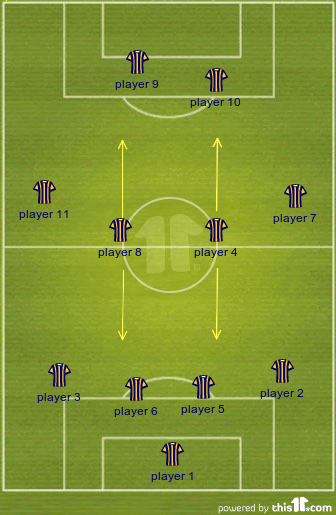
Swansea City play the 4-2-3-1 formation which has brought success to many clubs recently. Neil Warnock’s QPR side romped the Championship title playing the same formation, but changed tack once in the promised land of the Premier League, and as a result are struggling. Since signing Joey Barton QPR have tried 4-4-1-1 with Taarabt supporting the striker, they’ve tried 4-1-4-1 with Derry sitting in front of the defence, and they’ve tried 4-4-2 with Cisse and Zamora up top. Apart from the 4-4-2 games, QPR have had five in midfield, but the way they’ve set that midfield up has varied from game to game and it has sometimes showed. That’s not to say that football managers shouldn’t vary the way they play against different teams – of course they should. But to having no default can leave players struggling to understand their role in the team.

Swansea have not only outscored some of their more affluent and popular opponents, but in the majority of cases out-passed and out-played them too. When they faced Arsenal – a team generally reckoned to have the best passing game in the country – they hit 99 more passes than Arsenal, had a greater pass completion % and had more than 55% of possession. Possession is precious to Brendan Rogers. Against Manchester City they not only won 1-0 but again completed almost 100 more passes than their fancied adversaries, and again had over 55% possession. Incredible… you might say. But it’s not, once those passes are looked at in a bit more detail.

Almost all of Swansea's passes in the final third of the pitch originated in that zone. There are very few long hoofed balls up to a target man. And, as can be seen by the red arrow which eminate from Swansea's half, the long balls that were played were not very successful in keeping possession, which is Swansea's modus operandi. Compared to Fulham's passing - and remember fulham are the established Premier League side, and were playing at home. Far more long balls played up to the attackers, so consequently far fewer of those passes hit the mark. Territory, but not possession.

Against Arsenal, 54% of passes were either played backwards or square, and Swansea – despite the greater possession – had less of the territory. Against Manchester City it’s the same story. More passes than City, but over half didn’t go forward and Swansea spent more time in their own half than the other team’s. Even the 3-0 win over Fulham (With all due respect, less of a surprising result than wins over Arsenal and Manchester City) the trend continues, as seen in the images below:

Possession is precious to Swansea. Possession not only allows a team to create chances, but it stops opposition from creating their own. Against Fulham, a 3-0 victory was achieved, Swansea had far more of the ball, but were in their own half with it most of the time – of the little time that Fulham did get the ball, they managed more pass attempts (although not completions) than Swansea. Swansea are happy to play the Spanish style possession game – stylish, patient and effective. A continental style 4-2-3-1 with patient building through possession and short passes is effect tive against the “English way” of 4-4-2 and long balls up to a big number nine. The only surprise about Swansea is that they had the self-belief to stick to their guns after a bad start to the season. Because they did hold firm to their beliefs about how the game should be played, they are now reaping the rewards.

There are of course other issues that come with playing very well. A club such as Swansea, even with all the respect they've earned on the pitch this year, will struggle to keep hold of star players. Perhaps they were lucky in that way not to really hit the heights before the January transfer window closed. Blackpool where less fortunate - star midfielder Charlie Adam was linked with a move to Liverpool in January 2011, and Ian Holloway stood firm and rejected bids for his player in the belief that he needed him to stay up. Charlie then suffered a loss of form, Blackpool were relegated, and Adam now warms the bench and occasionally misses penalties for the Reds. What is very important for Swansea is the system. The system of simple short passes, possession at all costs, and pressing the opposition needs to be believed in. Team spirit is key to Swansea. The player most are talking about at Swansea is Leon Britton. A remarkable story even in a sport full of remarkable stories. Leon Britton has played in all four divisions with Swansea city, and now finds himselfi n the Premier League and with better passing statistics than anyone sharing a pitch with him. The Wandsworth born wizard has even achieved a better pass completion rate than Xavi at FC Barcelona.

His passing against Fulham rather beautifully describes Swansea's general style of play. Most of the passing takes place in his own half, the passes are short, often square of backwards, and 96% of them found the intended target. Simple really!

Images are taken from FourFourTwo Stats Zone App

Thursday, February 9, 2012

England's tactical journey under Capello

Capello’s departure just 4 months before a major tournament leaves a lot to be desired, and a bad taste in the mouth too. Whatever the reasons behind the reasons for his departure are, the presented facts are that Capello spoke out against the FA’s decision feeling that he had been undermined and declaring that he did not agree with the decision. Not wanting to try and read between the lines or speculate on national characteristics or personal attitudes and working relationships, the facts are that Capello has gone.


Looking back at his tenure, it’s difficult to sum up in simple terms. Yes, he has the highest win percentage of any England manager ever, but he also presided over the debacle of the 2010 World Cup, which was statistically England’s worst ever. Alf Ramsey won a lower percentage of games, but crucially won the World Cup in 1966. Bobby Robson has a lower win percentage than Steve McLaren, but is far more fondly remembered because he led the team to an agonising semi-final exit at Italia 90 whereas McLaren will be remembered for his humbling failure to reach Euro 2008. Performances when it counts is what a legacy is founded on. Fabio Capello England reign will most likely be remembered as a failure then, because of the dismal display in South Africa and quite frankly humiliating destruction by the hosts.

It is often said that more is learnt in defeat than in victory – ergo, Capello should only be considered a true failure if lessons from South Africa 2010 were not heeded. The most stark lesson was that the 4-4-2 was dead in the water on the international stage. So long the English national team’s bedrock and point of reference, its default and natural state; the 4-4-2 was demolished in 270 soul-destroying and 90 breathtaking minutes.


Indications are that, yes, lessons were learnt by Capello. He played England in a 4-4-2 just three times in the fifteen games since the World Cup (Admittedly winning all three).

When Capello was appointed, much was made of his disciplinarian nature – this was the man to break the dressing-room cliques, pop the inflated egos and crush player power. This was the man who dropped Beckham at Madrid, the man who had managed some of the greatest names in football’s illustrious history whilst in Italy and Spain, one of the most decorated managers in the domestic game. He did that to some extent, but not everyone got the message. John Terry’s failed revolution was, well… revolting.


He was also heralded as the manager to bring England up to date tactically. People must have forgotten his glory years at Milan were largely based on a 4-4-2 formation, and he played that same formation at Juventus and Real Madrid. Tactical innovator? Perhaps not. But he is a master at creating tactical systems to suit his playing staff. The perennial problem of managing a national side is an extrapolation of the old adage “you can chose your friends but you can’t chose your family” – Capello couldn’t buy Sergio Busquets from Spain, or Messi from Argentina, or Ozil from Germany; he had to work with what he had at his disposal. For a nation of footballers whose very bread and butter had been 4-4-2 since childhood, it would be tough to get those players to adapt.

A loss to France in his second game in charge when deploying his team in a 4-2-3-1 prompted a return to 4-4-2, and after winning two friendlies against USA and Trinidad using 4-4-2, Capello fell short again with a 4-2-3-1 by drawing with Czech Republic. The remainder of 2008 went well for Capello’s 4-4-2, in the next five games he only once deviated to a 4-3-3 against Kazakhstan winning 5-1 and the other four games were victories too. The final game in 2008 was a 2-1 win over a German team who were learning their own lessons in time for 2010.
Capello played 4-4-2 six times in his first year in charge – resulting in six wins out of six.

In 2009, Capello’s second year in charge of England, he suffered an educational defeat at the hands of a very proficient Spanish side (This defeat would be used as a benchmark against which a later victory would be compared – as evidence of progress) and this prompted a big change in tactics. The next six games were played using the popular and modern 4-2-3-1, in an attempt to replicate somehow the tiki-taka game of the Spanish national side, or Barca-without-Messi as they are better known. Only Holland could keep England from victory in that run of games. This was a great period for Capello, that run without loss lasted seven games in all, culminating in a huge 5-1 crushing of new rivals Croatia – that win used as a contrast to McLaren’s battles with Slaven Bilic. During those matches, Rooney was used in the middle of the attacking midfield trio, and scored 4 goals from that position over 6 games. Momentum was building – in the press and trickled down into the nation’s consciousness, 4-2-3-1 was the future, and England has the players to fit. Then the campaign to do away with 4-4-2 took a knock, a loss to Ukraine at the tail end of the year using 4-2-3-1 again prompted Capello to retreat to the safety of 4-4-2. The belief that if England lost using 4-4-2 then it would be England’s fault – the entire nation; or even more-so, the fear that suffering defeat whilst tactically experimenting would result in castigation, in the manner which McLaren was torn apart by the press after trying 3-5-2 in Zagreb. In 2009 4-2-3-1 was Capello’s most used formation, winning four out of seven games and losing just once. 4-4-2 was used only four times - two wins and two defeats.

But Capello used the safety net of 4-4-2 - following that defeat to Ukraine, England took the field in that old familiar formation. Momentum and spirit was raised with easy victories in the warm-up games, and then… well we all know what happened then. In 2010 England played 4-4-2 nine times, winning six but critically drawing twice and losing once. However, the safety net effect of 4-4-2 is still there. One can only imagine the uproar if England had have had such a dismal tournament and not played 4-4-2. But then of course, they might not have done so badly….


After England’s disgraced team returned home, the campaign to ditch the 4-4-2 was started up afresh. Since the World Cup, Capello has experimented far more than he had before (and of course, during). In 2011 England played nine games and only once trotted out in a 4-4-2, and that was the first game against Denmark, which England won 2-1 but were given a scare by wunderkind Christian Eriksen. It will be remembered as the year that Scott Parker finally established himself as the first choice defensive midfielder for England. Four times England have set out in variations of 4-1-4-1, three of those with Parker as the lynchpin, including of course the much heralded 1-0 victory over World Champions Spain. That performance has been rightly accredited as a fine defensive performance, much in the way that the famous 0-0 draw in the Stadio Olimpico was on the road to qualification for the 1998 World Cup. Scott Parker, Phil Jones and Gareth Barry were all used in the midfield during that game, more evidence that Capello had learnt from the World Cup
.
Crucially, Capello thought that the answer to the Lampard-Gerrard puzzle was Gareth Barry, and it wasn’t. Whilst Bobby Robson had the iconic image of Gazza crying to remember Italia 90 by, Capello’s legacy will forever be blighted by the images of Barry being completely outpaced and outclassed by a ruthless and mobile German attack. Blitzkreig indeed.

So, whilst he’ll always be remembered for what happened in Bloemfontein, Capello the disciplinarian used his time at the helm of England to nurse the team away from the comfort blanket of 4-4-2, even if he faltered spectacularly on the way. In the long term, the FA will hope that the disastrous campaign in South Africa can be used as a point to build up from, much in the way that Germany itself recovered from disappointing returns in the 1998 World Cup and even more-so from Euro 2000.

Sunday, August 14, 2011

Liverpool Vs Sunderland-Tactical Analysis


Liverpool gave league debuts to no less than four of their summer acquisitions, left-back Jose Enrique joining midfielders Charlie Adam, Stewart Downing and Jordan Henderson in the famous red of Liverpool for the first time. Sunderland themselves have brought no less than 10 players in the summer, and Steve Bruce gave debuts to Wes Brown and Sebastian Larsson, with David Vaughan made to wait until the 80th minute to renew acquaintance with fellow Blackpool old-boy Charlie Adam.


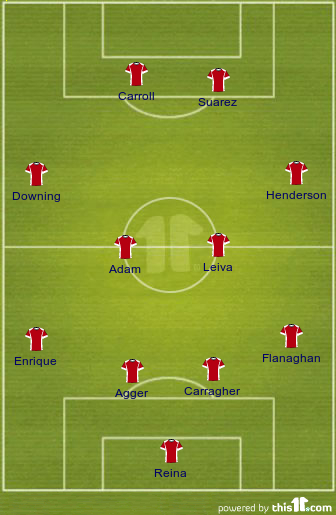
Somewhat surprisingly, Liverpool lined up in a 4-4-2 formation. Charlie Adam partnered Lucas Leiva in central midfield, with Stewart Downing and Jordan Henderson working the wings. Fans’ favourite Dirk Kuyt surprisingly relegated to the bench. The back four was also not what had been expected. New boy Jose Enrique, ink still wet on his Liverpool contract wore the number 3 at left-back, and at right back John Flanagan was preferred to Martin Kelly.


In truth, Liverpool’s formation was far more fluid than suggested by their line-up. Lucas and Adam both sat pretty deep, with Adam pulling the strings – although he played far less of his “Hollywood” balls than he did with Blackpool. Perhaps the reason for this is the better quality of his team mates, Adam felt less need to try the more audacious of his ideas. Stewart Downing started on the left, but was all over the pitch, and his most telling contribution came when cutting in from the opposite flank, striking the crossbar with a rasping shot after an impressive run. It has been expected that Carroll would play target man up top, but Liverpool linked with him far more successfully along the ground than by pumping high balls for him to challenge for as they did towards the end of the game as Liverpool searched for a winner. He was overshadowed yet again by Luis Suarez, already looking a fantastic piece of business, but to be fair Carroll was unlucky to have a goal ruled out for a foul. Replays showed the lightest of touches on the back of Anton Ferdinand. Carroll and Suarez both came deep to find the ball. At time Liverpool’s 4-4-2 evolved into 4-2-3-1, with either Carroll or Suarez taking their place at the pinnacle of that formation – Carroll actually had more deep touches than Suarez.


Sunderland in contrast deployed a 4-2-3-1 which could also conceivably be described as 4-4-1-1. Gyan supported by Benin international Sessegnon from an attacking midfield position. In reality the two formations are very similar but 4-4-1-1 is seen as far more conventional, it’s merely a 4-4-2 with one of the forwards withdrawn. Sunderland’s was probably more of a 4-2-3-1. The two central midfielders Cattermole and Colback are not the most attack minded of players, and they player with wingers high up the pitch.

Saturday, August 6, 2011

Signs From The Bridge-The Chelsea Preview

-Nitish Mhalgi


Another new manager in the dug-out, with almost the same crop of players again trusted to win the silver-wares that Roman so craves.Chelsea may be entering the new season with a brand-new coach and mentality, but there's still a strange familiarity in the air. The management may have changed, but the core of the team is still the same. It was the same, when Ancelotti began 2 years ago, or Scolari a year before that. The much talked-about rebuilding of the ageing squad is still not happening.Whether Chelsea's Old Guard still have it in them to take the team to glory again for one final year, only Time will tell.But, what are the likely options Chelsea will have this upcoming season, let's have a closer look.


 4-3-3 : The Conventional One

Despite all the rumours, Chelsea are still far from signing Luka Modric. With Javier Pastore having gone to PSG, there're no signs of a new creative play-maker in sight. So unless Villas Boas decides to hone Josh McEachran for that coveted role, Chelsea are likely to stick to the 4-3-3 formation this season. Oriol Romeu, the new recruit from Barca, is likely to challenge Jon Obi Mikel for the holding midfielder's role, with Lampard and most likely, Ramires completing the midfield. AVB is likely to choose either Drogba or Torres, rather than both.But, with Sturridge looking in top form, on which flank the Chelsea boss decides to play him, will decide who between Anelka and Malouda gets starts.No signs of changes in defense look imminent so far.

                                                  Torres/Drogba
               Malouda                                                              Sturridge


                      Lampard                                                Ramires
                                                         Mikel


   Cole                        Terry                           David Luiz              Ivanovic


 4-1-2-1-2 : The Midfield "Diamond"

First used by Carlo Ancelotti in recent times in English football, the Diamond formation did prove to be successful for Chelsea.What's more, this is Chelsea's best chance to make the Drogba-Torres partnership work. Carlo used it brilliantly, when similar doubts had been raised about Drogba-Anelka pairing.Sturridge could be given the free-roaming role at the tip of the diamond, but Yossi Benayoun seems tailor-made for ths role.The major issue for Chelsea would be to accommodate Lampard in this formation, as playing him on the left-wing deprives them of a natural winger,thereby leaving Ashley Cole to run the entire left side of the pitch.But even if only for the sake of Drogba-Torres pairing, trust AVB to experiment with this often, possibly against mid-table oppositions.


                                        Torres               Drogba
                                                  
                             
                                                   Benayoun


                       Lampard                                              Ramires


                                                       Mikel


   Cole                        Terry                           David Luiz              Ivanovic


4-2-3-1 : A different approach

In an approach totally different from what Chelsea have followed in recent times, Villas Boas can use either Lampard or Josh McEachran in a deep-lying play-maker's role, the kind of which Xavi or Andrea Pirlo play for their clubs. Oriol Romeu can sit as a "Sweeper" in front of the back four, with Ashley Cole and presumably Branislav Ivanovic being given license to bomb forward.It's another shot at making the coveted Striker Partnership work.Lampard and Benayoun can both play together in this system, while Modric can easily fit in the system too,if he does sign up.Either Sturridge or Malouda make up the left side of he midfield. 

                                                       Torres/Drogba


                          Malouda                       Benayoun                   Sturridge


                                                 McEachran
                                                                       Romeu
                         
                                                     
              Cole                        Terry                             David Luiz            Ivanovic


With the embarrassment of riches Chelsea have got in striking department, Anelka and Kalou are going to find it much harder to get starts, especially if Sturridge continues to be in top form.Best chance for the next imminent arrival, Romelu Lukaku seems to be January-February, when Drogba and co leave for African Cup of Nations. Whether Chelsea can get Modric will have a big impact on AVB's tactical set-up, although failing to get Modric might be a blessing in disguise, as it offers Josh McEachran a much more prominent role for the upcoming season.
In the end, whatever may be the tactics Villas Boas employs, including promoting the young players, he will have to produce the silverware right from the start. Carlo Ancelotti had to go, for finishing Second in one of the most competitive leagues in the world. Villas Boas might be Chelsea's best bet at the moment, but that's no reason for him to relax the slightest. There's a glimmer of Sunshine in the skies of West London now, but it'll take hell lot of work to make all the clouds part.


-Nitish Mhalgi
 Follow my Blog at :http://nitishmhalgi.blogspot.com/

Thursday, August 4, 2011

The Death Of The Box-To-Box Midfielder.


In English football, some of the most celebrated players in recent history have been the dynamic box-to-box midfielders. Typified by Lampard and Gerrard in recent times, their place in English hearts is secure. These players are seen as the heartbeat or engine room of a team. We here in Britain have historically placed more emphasis on physicality, strength and stamina over technical skill and tactical awareness. But seeing as the 4-4-2 is set to be replaced by 4-2-3-1 as the most popular formation in the english top-flight (It was a close second last year, but there has been two 4-4-2 teams relegated, and two 4-2-3-1 sides promoted from the championship) - what does this mean for our lung-busting, grass-covering box-to-box midfielders?


As the British game plays tactical catch-up with the continent, one of the more interesting changes we'll see is the way the midfield is structured. If we assume 4-2-3-1, or variations thereof, to be the formation used with most success, then the traditional "box-to-box" midfielder so highly prized in English football is on the way out. Midfielders will be arranged into more specialised roles. Of the three attacking midfielders, one will be in the trequartista role, behind a lone front man, and the other two will be wingers, or converted strikers in the case of Wayne Rooney, David Villa, and Dirk Kuyt. These players are rarely required to track back and help the team defend - although in Rooney's case it's often hard to stop him.

Packing the midfield with five midfielders has long been accused of being defensive in England, but this is not the case where three of those midfielders have such attacking roles. Yes, the two wingers will be put under pressure by opposition attacking full-backs, but at the same time, they'll be supported going forward by their own full-backs, who will provide width allowing the wingers to play almost as old-style inside forwards, as they drift towards the goal area.


The other two of the five midfielders, in contrast, will not be required to charge forward to join attacks as central midfielders in 4-4-2 formations have previously had to. Depending on the opposition, these players will either be defensive midfielders such as Mascherano, Van Bommel, De Rossi; or deep lying playmakers in the mould of Andrea Pirlo.

The question that a lot of English football managers will have to face is - If I've build a squad around 4-4-2, how do my players now fit into this new system. For the defenders, there's no real change - still a back four, full backs will still build partnerships with wingers, and central defenders will still do what they've always done. Up front, the 4-4-2 has produced some cracking parterships thoughout the years. The "big-man / little-man" combo has worked so well - good examples are Heskey and Owen, Beardsley and Rush, Crouch and Defoe. The new formations currently being played with success generally feature one striker up front. So there will be decisions about which player is able to lead the line on their own - will it have to be the big man? Andy Carroll looks like he'll play that role for Liverpool, but a natural finisher such as Javier Hernandez can't be asked to play anywhere but closest to the goal for Manchester United, surely? Other forwards will be asked to drop into the trequartista role, or pushed out onto the wings. I can think of players such as Van Persie in contention for a place with players such as Samir Nasri - forwards being asked to drop back, and midfielders being asked to push up - vying for the same position effectively.

The other positions in midfield are the two defensive midfielders, positoned in front of the back four. But will they both be asked to perform the same role? I think it's a step too far for the fans of the Premierleague to watch teams lining up with effectively more than half the outfield players lining up on defensive duties. Instead, I think that we'll see this partnership being comprised in a similar way to some of the great central midfield partnerships produced from the 4-4-2. Keane and Scholes, Makelele and Zidane, Simeone and Veron. All parings of two distinctly different players. One for defensive duties, and one for attacking. So, in order to function properly, a 4-2-3-1 must also have a similar partnership at its heart. A defensive midfielder in the Makelele role - players like Flamini, van Bommel, Hargreaves (when fit - and wherever he ends up!) and Mascherano. The other player must look to link defense and attack. This player will take up a deep lying role, working alongside a player who will win the ball off the opposition and then pass it five or ten yards to his more creative partner - then he will put his head up, and look for the runs of his team-mates. Much like a quarter-back in American Football.


Perhaps the best example of a deep-lying playmaker is indeed one that was converted from trequartista - Andrea Pirlo. He perhaps even deserves to have the position named after him.

Pirlo, of course, has the benefit of playing with one of the best ball-winners in the game - Gennaro Gattuso. It's a very simple system - Gattuso or one of the back four wins the ball from the opposition, and then gives it to Pirlo. Pirlo has excellent vision and awareness - his team mates know this, so as soon as he gets the ball they set off on runs, trying to get into a bit of space to get the ball, they know Pirlo can make that pass.


There are players on these shores which already specialise in this position, but they are quite rare - why do you think Liverpool were so keen to get their hands on Charlie Adam? I'll tell you why - because they shouldn't have sold Xabi Alonso, that's why.

Players such as Michael Carrick, Tom Huddlestone, Joey Barton (Again, wherever he ends up) and Jack Rodwell would all siut this role particularly well. But most interesting, in my view, is the players who like Pirlo would suit a conversion from attcking midfielder to deep-lying playmaker.

Ryan giggs is one of those who has already made the switch - in order to prolong his career, he's swapped bombing up and down the wing for a more withdrawn role. As the quarterback position doesn't necessarily involve a lot of movement whilst on the ball, or a lot of chasing and tracking when not in position, this job would suit a lot of players coming into their thirties. Players such as the aforementioned Gerrard and Lampard might be able to make the switch in this coming season or the next, although it has to be said that there is some question whether either player would have the necessary discipline required to sit back and dictate play, rather than get forward and join in. Lampard in particular glories in holding onto the ball in an attempt to finish a move himself - or looking to play one-twos for the same reason. The main attributs needed for a successful deep-lying playmaker are vision, creativity and the ability to execute the pass once spotted.

It used to be said that many a foreign import didn't adapt to the premiership - the example of Veron psrings to mind. If the English Premiership had been more tactically advanced I'm sure he would have been a far greater success. Maybe we just weren't ready for him?

Since the watershed moment of the 2010 World Cup disaster for England, it has become the case that the Premiership will adapt itself to accomodate these players, rather than trying to shoe-horn them into a 4-4-2. As I said earlier, the continent is still advanced with regard to tactics compared to the premiership - that's why players such as Nuri Sahin at Real Madrid, Arturo Vidal at Bayer Leverkusen (just snapped up by Juventus) are so highly thought of, and snapping at their heels ready to make a big money move are players such as Steven Defour at Standard Liege, Moussa Sissoko at Toulouse, and Joao Moutinho at Porto.

Wednesday, July 27, 2011

The Curious Case Of Alberto Aquilani


At the moment, the Anfield future of Alberto Aquilani hangs in the balance. His agent Franco Zavaglia has made more u-turns than the coalition Government in Westminster – often only a matter of days after a statement declaring that Aquilani will definitely stay, another statement is released to the contrary. Another season long-loan has been mooted, and the absurdity of that discussed widely – even if his wages are paid by the club loaning him in, surely his value will only diminish as his contract runs down? Moneyball must have a chapter on this!


When Alberto Aquilani signed for Liverpool in August 2009 for £17 million, it must be said that not much was known about him. This is despite him being a full Italy international, and a key component of a Roma team that finished 2nd in Serie A the previous season. It must also be said that 2 years down the line, not much more is known about him than was then.


It also appears that Rafa Benitez might not have known much about him. Aquilani was supposedly bought as a replacement for the departed Xabi Alonso, who had moved to Real Madrid, but they actually play very different roles within the bracket of central midfielder. He is perhaps closer in style to Steven Gerrard, playing higher up the pitch and breaking into the box during attacks. And seeing as Liverpool’s talismanic captain is 31 years of age, looking for a replacement is something that might have to be done soon. Gerrard isn’t one of those players who will last forever, his high tempo powerful game has taken its toll on his body, particularly his knees. But, so it was – Alonso went to Madrid and Liveprool signed Aquilani. It must be very difficult to replace a fans’ favourite, particularly one who is talked about by those who say they know about football as probably more important to Liverpool’s performances in recent seasons than even Gerrard. An injury delayed debut only heaped more pressure on him, and his fitness was often questioned. He made 26 appearances in the 2009-10 season, some as substitute. The season before his move to Liverpool, Aquilani played a mere 20 games for Roma, and his injury record over the previous 3 years definitely puts him in the box marked “prone”.

Roma, alongside most major European clubs, played a variant of the currently popular 4-2-3-1 formation, and Aquilani was for the majority the focus of the three-man attacking trio, although he’s displayed some versatility by being used on either flank, sometimes as one of the double-pivot holding midfielders, and also as the trequartista when Roma witched it up a bit. He has scored a few spectacular and important long range goals for Roma and his reputation in Italy is significantly higher than it is in England.

In 2009-10 Liverpool also generally played 4-2-3-1, but Aquilani was generally used as one of the two holding players, and even then was third choice at best behind Javier Mascherano and Lucas Leiva – a tough double act to break up, especially if it is not your favoured position. The preferred players in the attacking trio behind Torres were Kuyt, Gerrard and Babel/Maxi/Aurelio/Riera.

Still, 26 games for an injury hit debut season isn’t too bad, and it’s often the case that a player brought in from another league takes a season to adjust to the style of the Premiership. There was a feeling among Liverpool fans that the best was yet to be seen from Alberto Aquilani. However, Benitez made way for one of the most unpopular managerial appointments in recent years – the doomed Roy Hodgeson. Hodgeson decided that Aquilani should be sent out on loan, back to his mother country in order to gain match fitness – obviously not putting much faith in the physiotherapy and physical training facilities at Melwood. He went straight into the team at Juventus, where he played in the middle of a 4-4-2, as the more creative of the central pair alongside Felipe Melo, a defensively minded player.

Since his return to England, Aquilani has been making the news simply because people are finally finding out that he’s not a bad player. You don’t get to represent Italy at all levels from under-14 upwards if you’re a bad player. Owner John W Henry misspelt his name on twitter, such was his urgency to declare Aquilani as Liverpool’s “missing link last year”. Strange comments from an owner who has just forked out a medium-sized fortune on Jordan Henderson and Charlie Adam. They’ve now got about 8-10 central midfielders, depending on who makes the first team squad. To put that into a perspective that the average man might understand, that’s like your boss buying two new computers for the office, then finding one under his desk and saying it’s the best model. Add into the mix Assistant boss Steve Clarke praising fellow Chelsea old-boy Joe Cole, and you’re left wondering if they’ll bother with defenders or attackers in the coming season.

With Liverpool generally reckoned to be playing either a 4-2-3-1 or a 4-3-3 (or somewhere in between) next season, you’d have to say that competition for places is going to be fierce.

Looking at further length into the likely starters in a 4-2-3-1, it’s probably fair to say that the double pivot of holding midfielders will be Lucas Leiva and Charlie Adam. Leiva fulfilling the destructive element of that pairing, and Adam playing as a deep-lying playmaker, in the mould of Andrea Pirlo, or indeed Xabi Alonso. Back-ups to these positions would be Poulsen if he’s still there, and at a push Spearing and Meireles. The make-up of the attacking trio behind the main striker is a little harder to speculate. On the wings there are the options of Aquilani, Downing, Henderson, Joe Cole, Rodriguez, and of course Kuyt has been used there, as has Luis Suarez – even Steven Gerrard could do a job there, although he’ll probably be nailed on to play the central role of that attacking part of midfield. The position behind the front man, Aquilani’s favoured position, is also one that could be assigned to one of many. As I’ve said, Gerrard will get the most starts there, but if he remains at Anfield, Aquilani is certain to be a contender for that place, given Gerrard’s poor showing last year, and the question marks over his fitness now. Other contenders for that job are Joe Cole again, and perhaps Jordan Henderson.

What Liverpool are doing here is assembling a squad of players who are specialists at one position, but have the versatility to play one or more others. This gives them quality cover for injuries, options for rotation, and intense competition for places to motivate the players to perform consistently. They do not yet have the strength in depth that was the hallmark of the Manchester United and Chelsea title winning teams of the last decade, but their not far off. So, whilst I wouldn’t say that Aquilani is the player who will win them a Premiership title, he’s the kind of player you need in your squad to have the strength to challenge.

Tuesday, July 12, 2011

Why England Never Win!


Football has long been talked about in terms of tactics. We hear things like W-M, we nod our heads sagely as someone in the pub murmurs the word catenaccio – although we don’t know what it means.Christmas trees, 4-4-2s, liberos and “Total Football”.

What makes football worth watching is it’s unpredictability. Americans seem to prefer sports which can be analysed with statistics, so numbers can be crunched and comparisons can be made. I seem to remember a statistic being flashed up on the screen during USA ’94 which announced that a particular player had made the highest number of long passes in the competition – and the English commentator sniffily remarking that this was not necessarily a good thing. America likes its numbers. But the beauty of football is that only two numbers really count at the end of the game. How many goals your team scored, and how many theirs did. We don’t memorise facts and figures. A quick poll: How many goals did Paul Gascoigne score for England? Don’t know? But I bet we can all remember the flick over Colin Hendry at Wembley in 1996 and the volley into the bottom corner. I bet we all remember too that it bounced once before crossing the line, but was otherwise aesthetically perfect. Football a game of aesthetic realisation, or as somebody more succinctly put – the beautiful game. An art, rather than a science.


The most admired players – by this I mean admired by everyone from fans to Chairmen, are the players who can make a mockery of tactics and formations. These are the players that excite the crowd, get them off their feet. The inventive players, who use nothing more than natural instinct to create space, pick a pass or find the top corner of the net. Players like this – the true greats of the game – needn’t be top of the stats in every respect. Giovanni Van Bronkhurst played for Holland more than twice as many times as Johan Cryuff, but you wouldn’t get the whole crowd rising to their feet when Gio received the ball. When people are asked to name their top 5 players ever, Van Bronkhurst doesn’t make the cut, he probably doesn’t even make most people’s top 5 Dutch footballers. Bebeto scored far more goals than Rivelino, but is less revered (Anyone heard of “the elastico”? Rivelino). The biggest transfer fees, the highest wages, the most shirt sales, the loudest songs, the most emulation, adulation and commemoration go to the best entertainers - the creative attacking midfielders, wingers and forwards who have the ability to amaze and astound.


The exception of course, is England players. For some reason we seem to view our own in a different light. We are more critical of English flair players than we are of those born abroad. Our fixation with 4-4-2 at international level is perhaps one of the reasons. I think it lies deeper than that. From youth level, players are coached and schooled into tactical rigidity. Can you imagine a school-boy footballer being afforded a free-role? No. He’d be played centre midfield, and told to work on his defensive play. Kids are taught that strength, pace, and power are favourable to skilful technique and trickery.


Football is, at the end of the day, entertainment. However money-orientated, results driven, or tactically ingenious it becomes, it still has to enthral, excite and enrapture us otherwise it will lose the power to keep our attention, lose the ability to swell our hearts, and lose the right to empty our pockets. The key to this is tactical evolution. It was tactical evolution that allowed Hungary to destroy England in 1953 – a deep lying forward drew defenders out of position, and Puskas and Kocsis put them to the sword; it was tactical evolution that produced the famous Total Football; and it was tactical evolution that allowed Germany to rip England to shreds at the 2010 World Cup.


For years England have had “The left sided problem”. A lack of a top class left winger leaves a country obsessed with the 4-4-2 in quite a pickle. It rarely occured to anyone that perhaps we should play in a formation that doesn’t need a left winger. A 5-3-2 using Ashley Cole as a rampaging wing back sounds good to me, as does 4-3-2-1 as employed recently by Argentina, or a 4-3-1-2 favoured by Spain. Instead we have persevered with playing centre midfielders out of position. Steve Gerrard and Joe Cole have both been played there, and both drift infield, leaving a huge hole. Although Gerrard’s link ups with Rooney in the 2010 Qualifiers gave us all hope. Terrible thing, hope. We now have a few players who could fill that position, Adam Johnson, Ashley Young and Stewart Downing. However, Adam Johnson, when he can get a game, is often used on the right of midfield; Ashley Young in the middle of the park, and Stewart Downing on the right a fair proportion of the time. The clubs that provide those players regularly play a 4-2-3-1 system, as do most of the top sides in England and across Europe. The top sides are the ones which provide the vast majority of players in the England squads, and those players are then asked to play in different formations to the ones they use week-in week-out.


England play dull football. Let me qualify that - The English national side is viewed from both within these shores and without as a fast-paced, energetic and powerful team. Kick and rush, long ball, physical football, with a big man / little man combo up front, and two lines of four behind them. Since time immemorial England have set out in a 4-4-2 formation. A game in 1990 against the Dutch is remarkable for the fact Bobby Robson played Terry Butcher as a sweeper, people still remember that over 20 years on. Experimentation by Terry Venables with the Christmas Tree formation at Euro ’96 is a notable exception to the 4-4-2 devotion. Another, more recent experiment away from 4-4-2 was tried by the hapless and much ridiculed Wally with a Brolly Steve McLaren. The experiment failed, and was abandoned. That’s what happens when you mess with the English formation – you have an insulting nickname made up by the media, and you are sacked by the FA. McLaren was probably not right to tinker about in an important away qualifier against Croatia, but that result amongst others resulted in England failing to qualify for the European Championships, so he had to go. To be fair, he was awfully hampered by injuries to key players. Our media-driven haughtiness allowed us to think that if we had qualified, we’d have been amongst the favourites – the next World Cup put paid to that assumption, it was our worst in history. That was under the tutelage of Fabio Capello, a man with an outstanding record in club football, who was supposed to bring a more mature, more modern approach to our international football. He’s been lambasted for that dismal set of performances in South Africa, but can you imagine if he’d played another formation and failed? The burning effigy trade that has lain dormant since 1998 would have been unable to cope with demand.


So, technically we’re decades behind, and tactically we’re at least 10 years out of date. Capello was supposed to be the man with his finger on the pulse of top class football, who could rejuvenate England’s fortunes with his tactical know-how and trendy European ways.

But is he that man?


At Milan in the early nineties, arguably Capello’s most celebrated years, he mostly played a 4-4-2 with Rikjaard and Albertini across the middle of the midfield, and later replaced Rikjaard with Desailly. However, don’t forget, his early 90s Milan had an unbelievable and legendary back 5, and Gullit and Van Basten up front. How England could do with those riches. At Roma he fielded a 5-3-2, to incorporate two of the best wing backs the game has ever seen – Cafu and Candela, encouraging them to bomb forward, but again had a defensive midfield comprising of two from Zanetti, Emerson and Tomassi.At Juventus, he reverted to 4-4-2 tactics, this time with Emerson again in tandem with Partick Vieira. He took Emerson with him to Real Madrid for his second, season long, term there. He was sacked despite winning La Liga, because of the defensive way his teams played, he varied generally between a 4-2-3-1 and a 4-4-2.

Throughout his career, Capello has been successful with the 4-4-2, perhaps this is why the FA chose him. The FA, being English, are also obsessed with the 4-4-2.

So, Capello has the ability and nous to adapt formations when he squad he inherits has players of outstanding ability who will not fit into his favoured 4-4-2. With England, we’ve now got the players who can fit that formation – the left sided problem detailed above now seemingly solved, but he’s further constrained by our country’s obsession with Lampard and Gerrard. There is no doubt that Fabio Capello knows how to make a 4-4-2 work, but the longer these two attacking central midfielders remain (in the hearts and minds of England supporters) un-droppable he’s got a problem. To ask either of them to sit back and protect has proved to much for them so far – they don’t lack the intelligence, it’s just not their natural game. To ask both of them to stay back and protect is simply out of the question, and absurd to boot – you’ve just got to get different players in. Gerrard and Lampard can’t ever be Rikjaard and Desailly, or Emerson and Vieira, and those are the types of players needed for a Capello 4-4-2. The disciplined, defensive midfield pairing necessitates a lot of work from the wingers, and also needs the full-back to get forward and allow those wingers to drift infield if numbers are needed up top. By using the two central midfielders as shields, the Capello 4-4-2 allows greater freedom for other positions. Oh, for a fully fit Owen Hargreaves!

There has been much talk in the media and in pubs and cafés across England since the World Cup disaster demanding a break away from the 4-4-2. Perhaps the mood of the nation is turning at last. Perhaps it will take a lot longer still. It is still the default formation in the minds of every Englishman who pulls on a pair of boots. If we can’t manage to escape it, we need Capello to be brave enough to thank Frank and Steve for all they have done, and show them to door.

The other option, if we can stomach it, is to go with the current trend of 4-2-3-1. Again looking at Gerrard and Lampard we can easily see that one of them would fit very nicely into the middle of the attacking midfield triplet. Who to choose? It’s fair to say that neither of them have reached the heights reached in their club careers, so what we’re left with is a choice between one of two players who have failed to deliver, or bringing someone new in. Step up Jack Wilshere. The Arsenal youngster was sorely missed at the U-21 Euros, although when you consider that Stuart Pearce played Michael Mancienne in midfield ahead of Muamba and Cleverly, perhaps whichever players had been in the squad the end result might’ve been the same. Jack Wilshere is the latest of our great white hopes. There are a few players in and around the U-21 set-up that make you sit up, and he’s the pick of the bunch. If Capello were to build a team around him, for example putting him in the middle of the three attacking midfielders, and just let the boy play, we could find out that he’s the formation-busting instinctive creator that we’ve missed since Joe Cole was over-hyped. He’s also been used by Wenger as a deep-lying midfielder, doing a fair bit of ball-winning, but more of a withdrawn playmaker (Think Pirlo rather than Gatusso – or for a less dreamy comparison, think Michael Carrick rather than Joey Barton). So, you could put him in one of the two defensive midfield slots, if you wanted for example Rooney behind Carroll/Bent as the team’s focus.


Basically, we play boring and ineffective football because as a sporting culture, we’ve failed to adapt. We’ve been failing to adapt since 1966, when it was us who had the tactical innovation when a 4-4-2 shifted to either a 4-3-3 with Charlton joining the attack, or a 4-2-4 with Marin Peters and Alan Ball rushing up the sides.


Our current options appear to be limited to adopting the en vogue 4-2-3-1, which would simply mean that we’re catching up to what other nations have been doing for years, or sticking to the 4-4-2 but doing it Capello style. Neither of them exactly evolution, which is what’s needed. My personal view is that we should keep an eye on what Villas-Boas can achieve with Chelsea. His Porto side swept all aside last season, and if he makes it work at a top Premier League club, perhaps this brand of attacking 4-3-3 is the next evolutionary step that we should adopt.


But on a more nationwide level, we need to accept that just because we invented association football, it doesn’t owe us a guaranteed romp to the semi’s of every tournament.


-Tom Nash

Saturday, July 2, 2011

How Will Liverpool Set Up in 2011/2012?


Liverpool’s form dramatically changed last season when the unhappy reign of Roy Hodgson ended and “King Kenny” was promoted from Head of the Academy to Manager of the first team. Most believed that Dalglish was going to implement the 4-4-2 he favoured when he was in charge of Blackburn. However, Dalglish knows this formation is outdated especially at a higher level and so chose to switch to the 4-2-3-1, one of the more popular formations in recent years.


So with Liverpool being active in the Transfer Market,how is Dalglish going to change his tactics next season.Here in this article we look at two formations both of them which Dalglish used last year,the 4-2-3-1 and the 3-5-2.


4-2-3-1

The first formation is classic 4-2-3-1. It became Dalglish’s favoured formation at the end of last season. This formation is well suited to this Liverpool side especially Gerrard, Lucas Leiva and Glen Johnson. With the transfer of Charlie Adam imminent as well, I think we may be watching a very Benitez style double pivot (Alonso/Mascherano), with Adam as the creator and Lucas as the destroyer. If this does happen Gerrard will probably be pushed further forward with one of the front four dropping to the bench.


However I’m not sure how new signing Jordan Henderson will fit in this formation as he has only really be seen in a 4-4-2 for Sunderland, and was poor for England u21’s this summer while playing in a pivot. Another midfielder who has been missed out from my starting line-up is Raul Meireles. His form rose at the same time as Liverpool’s last season, but has been rumoured to be leaving, with Dalglish putting an onus on home-grown talent.
Dalglish emphasises attacking football and a free flowing front 4, with the width getting provided by the full backs. For this to happen the front man needs to have good movement into either the channels or by dropping into the midfield. Kuyt arguably did this the best last season. In his hat-trick against Manchester United, Kuyt did everything which Dalglish would want him to do, moving into channels, holding the ball up, dropping deep and also making runs behind the defence to stretch the play and to make space for Suarez. Whether Carroll can do this as effectively as Kuyt is still a doubt for me because he lacks the same mobility. However, arguably what Carroll lacks in mobility, he more than makes up for with his aerial strength.
Lucas is a key man in this formation. Voted as Liverpool’s player of the season last year, his tackling and passing are superb, and this allows Liverpool to have the time to go from their defensive form to their attacking form. Essentially it will allow the midfield to get into position and allow the full backs to get into the oppositions half.
A positive with this formation is the numerical advantage in midfield. This allows Liverpool to keep possession more easily. Another advantage though which was highlighted in the game against Wolves away, was that this formation allows runners from midfield which can be very hard to track if the opposition only has 2 central midfielders compared to Liverpool’s three. If the striker drops off
the central defenders to become a false nine, it opens up gaps in the defence which midfielders like Gerrard, or in the case of Wolves, Meireles, will more than happily exploit.


3-5-2


Another formation favoured by Dalglish is a 3-5-2 or a 3-4-2-1. This formation was used notably against Stoke when Dalglish felt he needed the extra height needed in set plays so played more centre backs. Although this formation will mainly be used as an alternative to the favoured 4-2-3-1 it still has many positives.
A key component in this formation is the wing backs. Johnson has the energy and pace for this but I do not think Insua or Aurelio do. This position is definitely an area which needs improving and the attacking capabilities of Baines or Enrique would be better suited here. Kelly and Flanagan both performed admirably when called upon but both are still too young for the responsibility in these positions as starters. They will still provide adequate cover though when called upon.


Yet again Dalglish uses a double pivot and as previously discussed he has a wealth of choices here, even the forgotten about Aquilani may push for an occasional start, as well as the hard working Jay Spearing. The midfield shape can also change. An example of this, is the switch into a midfield diamond when away to Chelsea, in this case Dalglish used this to match up with Chelsea’s formation in midfield. As a result, Liverpool nicked a 1-0 win and Torres and Drogba were anonymous as they were kept quiet by the three man defence. This is another example of Dalglish’s emphasis on fluidity in his formations, a key component if Liverpool is to be successful next season.
Expect the front three to be fluid again, with Rodriguez, Gerrard, Kuyt, Suarez, Henderson or Meireles all able to do a job in these roles. Whether Dalglish decides to rotate these players, or settle on a definitive starting line-up will be interesting as he has a host of big name players which he needs to keep happy for any chance of success.
Do not expect these formations to be the only ones which Dalglish uses, as he has shown by how he lined up against Chelsea he is more than willing to change the set-up of his side to stop the opposition, especially away from home.
With players and fans all seemingly excited by next season and now happy to be associated with the football club again it would be wrong to rule out Liverpool next season, especially with Liverpool’s intelligent back room staff including Steve Clarke and Damien Comolli. Therefore, if Dalglish brings in a left back, I really think that this squad has the ability to break the domination of Manchester United and Chelsea in recent years.

-Greg Cooper (itsaballnotabomb)